How to Turn Your PSA Integration Into a Competitive Moat Before a Larger Vendor Enters Your Market
A deep PSA integration is one of the few moats a smaller vendor can build that a larger competitor cannot easily replicate.
There is a moment that most channel vendor leadership teams dread and almost none plan for explicitly. A larger, better-funded competitor announces support for the same PSA ecosystem. Their product is not necessarily better. But their brand is bigger, their sales team is larger, and their marketing budget is orders of magnitude higher. The question becomes: what defensible position do we hold that they cannot quickly replicate?
For vendors who have invested deliberately in their PSA integration, the answer is often the integration itself. Not because a large competitor cannot build a competing integration, but because a deep, well-maintained, MSP-embedded integration takes years of accumulated context to replicate. The competitor can announce integration support. They cannot quickly replicate the edge case handling, the MSP-specific configuration options, the support expertise, and the peer word-of-mouth that a vendor with three years of active integration work has built.
This is a genuine moat. It is not permanent and it is not impenetrable. But it is real, and it is buildable by vendors who understand what creates it.
What Makes a PSA Integration Actually Defensible?
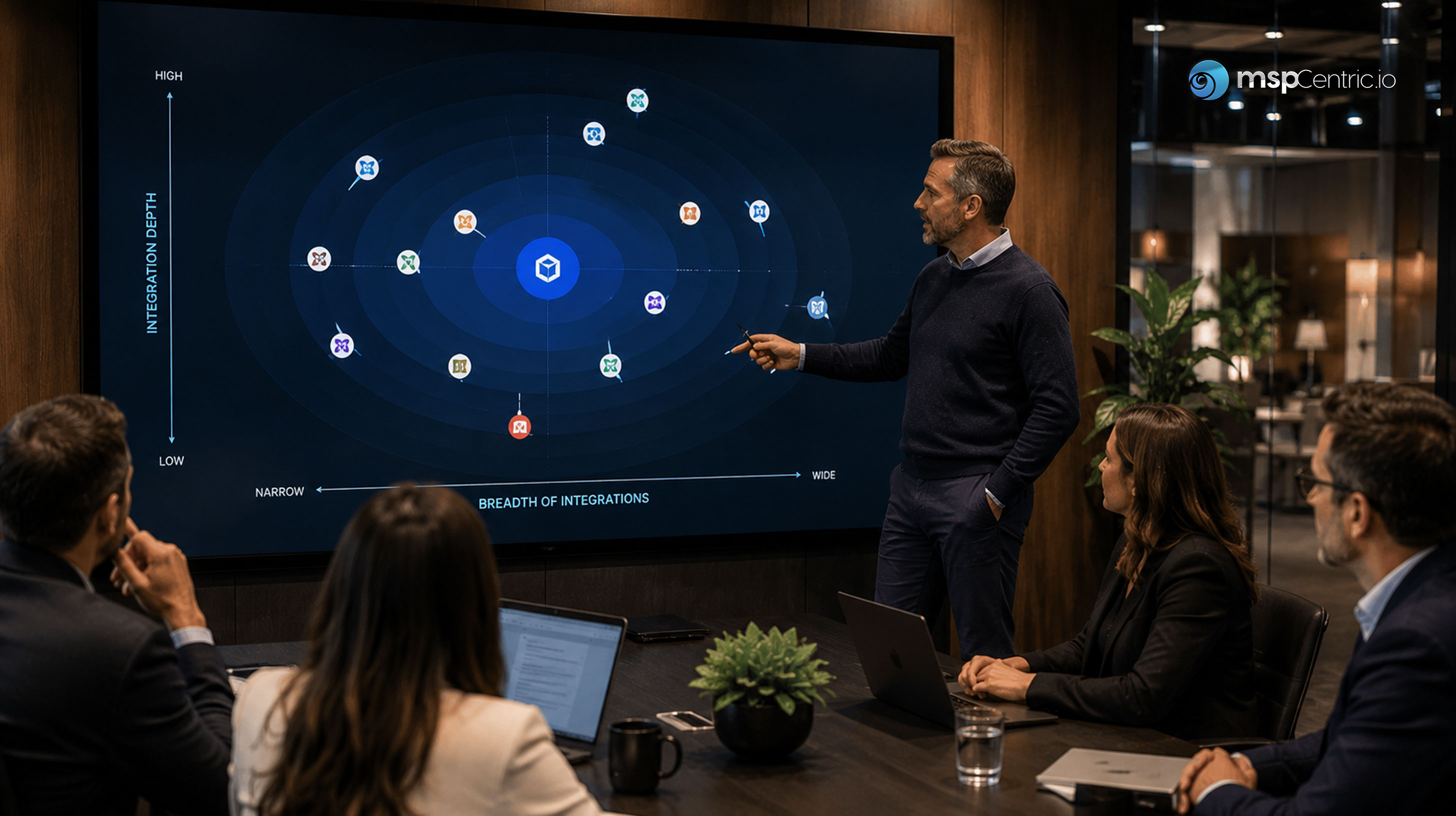
Not breadth. The vendor who has a surface-level integration with five PSA platforms is not more defensible than one with a deep integration with two. Breadth without depth creates the appearance of coverage without the operational reality of it. MSPs who use a shallow integration in their core workflow quickly learn its limitations. A competitor who builds a deeper integration with the same PSA takes that MSP relatively easily.
Depth is what creates defensibility. And depth has a specific meaning in the PSA integration context: the integration handles the workflows that matter most to MSPs in their actual environments, not just in standard configurations. It handles the edge cases that only appear in production. It syncs the data that MSPs actually need synchronized, not just the data that was easy to sync first.
The second component of defensibility is switching cost. An integration that has become embedded in how an MSP runs their billing cycle, their ticket routing, or their client reporting is genuinely difficult to replace. The MSP has built workflows around it. Their team has learned it. The data it maintains has history. A competitor offering a marginally better integration will struggle to displace one that has reached this level of operational embedding.
The third component is community reputation. In the MSP channel, peer recommendations drive more integration adoption than any marketing campaign. A vendor whose integration is mentioned positively in peer communities, at events, and in community Slack channels has a reputation asset that a new entrant cannot buy and cannot replicate quickly. Building this reputation requires consistently delivering on the integration's promises over time — which means the moat compounds with every satisfied MSP partner.
How Do Vendors Build Integration Depth Deliberately?
By investing in integration improvement as a continuous practice rather than a launch-and-maintain activity. Most vendors invest heavily in the integration at launch and then shift engineering resources elsewhere once the integration is functional. This is exactly the period when a deliberate investment in deepening the integration — handling more edge cases, improving sync fidelity, adding workflow-specific capabilities — would compound into a competitive position.
The vendors who build durable integration moats treat integration improvement as a product investment, not a maintenance obligation. They track which capabilities their most successful MSP partners rely on most, invest in making those capabilities better, and communicate their investment trajectory to partners in a way that builds confidence in the long-term relationship.
When a larger competitor enters the market, these vendors have a conversation that is genuinely difficult for the newcomer to replicate: "We have been building this integration for three years. Here is what we know about how MSPs in your configuration use it. Here is what we have built specifically for environments like yours. Here is what is coming next."
That conversation is a moat. Building it requires time and consistent investment. But for vendors who make that investment deliberately, it is one of the most durable competitive positions available.
How Does MSPCentric Help Vendors Build This Position Faster?
By accelerating the depth of integration that vendors can deliver without proportional engineering investment. Vendors who partner with MSPCentric to build and maintain their PSA integrations can invest the engineering capacity they would have spent on integration maintenance into the product work that differentiates them in the market — while the integration itself is maintained and improved by a team with accumulated PSA-specific expertise. The moat builds faster. The engineering capacity is preserved for the work that compounds the moat.
FAQ
What makes a PSA integration a genuine competitive moat?
Depth, switching cost, and community reputation. An integration that handles real-world edge cases, embeds itself in MSP operational workflows, and earns peer endorsement in the MSP community is genuinely difficult for a new entrant to replicate, regardless of their budget or brand size.
Why is breadth less defensible than depth in PSA integration strategy?
Because surface-level integrations with many PSA platforms are relatively easy to replicate. Deep integrations with specific platforms that handle production edge cases and embed in MSP workflows require years of accumulated context that cannot be quickly reproduced, even by well-funded competitors.
How do vendors build integration depth deliberately rather than by accident?
By treating integration improvement as a continuous product investment rather than a launch-and-maintain activity. Tracking which capabilities matter most to successful MSP partners, investing in making those capabilities better, and communicating the investment trajectory to partners are the practices that compound into a defensible position over time.
Subscribe to our newsletter today
Stay tuned for all things MSPCentric and PSA integrations.